In which our Diva has recently spent a number of highly satisfying hours in the dark
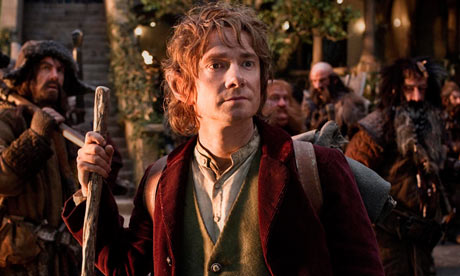
'Tis the season for actually getting out to the cinema more often than usual, and with two highly-anticipated adaptations of things near and dear to my heart for many years, this year has been no exception.
First up was The Hobbit, which I'm not too proud to admit I've seen three times. Two of those were in the much-discussed HFR (high frame rate) format, which, while I see where those who dislike it are coming from, I'm going to have to declare myself in favor of. (Though it's interesting that it's the frame rate that's getting all the attention, when I think a lot of the look also comes from the RED-EPIC camera's extremely high resolution.) It took a little getting used to -- as I've been explaining it, my brain spent a good chunk of the prologue switching between interpreting what I was seeing as "video" or "right in front of me" before cementing a new perceptual category -- but by the time Bilbo was unexpectedly accumulating Dwarves in his dining room, I didn't find it obtrusive at all.
Much has been made of it as a vehicle for showing the sweeping vistas of New-Zealand-as-Middle-earth, but I was equally struck by how much it allows the audience to see the finest nuances of an actor's performance. And there are plenty of those to be seen in The Hobbit, from the entire ensemble. The fun part about seeing it more than once was being able to watch all the character stuff going on in the background, and there's plenty to see. Thorin looking out for his nephews, and his nephews (particularly Kili) looking to him for cues on how to behave and whether they're impressing him. Balin keeping a weather eye on his long-grown-up protege. All sorts of other things that make the huge troop of characters distinctive and memorable.
Speaking of capturing performances, of course, Andy Serkis' time covered in little dots was tremendously well spent as always. Without detracting from the tremendous technical and, yes, artistic skill of the team who put Gollum's image on the screen, it's been great over the past several years to see that people understand that their work isn't replacing the actor -- as some doomsayers were predicting for a while there -- but providing a new way to change his appearance, as the artistry of costume designers and makeup artists has done for centuries before them. The technical advances made since the Lord of the Rings trilogy a decade ago have been entirely in the service of all the more faithfully showing us his work, with greater capacity to capture nuances of expression like the movement of tiny muscles around his eyes. Anyone who tries to tell you what he does -- and what we see -- isn't acting? Has no idea what they're talking about.
And yeah, New Zealand is pretty too, and the production design is as gorgeous as ever. Impressive production values don't make a movie good, but they also don't prevent it from having heart, and there's plenty here. The seven-year-old kid who loved the book, and who went on to plunge into the rest when her reading level would allow it, has grown up very happy with what this team has created on screen.
If the adventures of the Company of Thorin had me grinning at the screen for the better part of (three times) three hours, I was just as happy to spend a similar stretch of time mostly crying my eyes out. Though, after some 25 years of familiarity with Les Miserables, I really should have known better than to go with only two measly kleenex in my purse! I ended up clutching a useless sodden ball by the time the barricade was going up. Oops.
A good chunk of that is down to Anne Hathaway's absolutely heartrending Fantine, though again, I was happy with all the performances. I have a quibble here and there with voices, despite having accepted years ago that movie-musical singing is different from musical theatre singing in much the way movie acting is different from theatre acting. And, in much the same way, it's evolving to keep pace with technical developments and audience tastes. But all the characters were right there, newly vivid in many ways as they were illuminated by the perspective of film and the tweaks to the text. Closeups and angles provide opportunties for minor characters -- notably little Eponine and several of the students -- to shine in non-verbal moments that might go unnoticed on stage.
I could go on and on, but the bottom line is, it's amazing, they did an amazing job. Not that there was anything wrong with my faith in the future of the movie musical, but I still feel really really good about it now.
I know these are both HUGE movies that don't need any help from me. But sometimes the blockbusters really do have the heart and the art. And this is my blog, and it's the holidays, and I felt like gushing about movies that make me happy.
I hope you're finding things this holiday season that make you happy too.
In which our Diva is once again thankful for Netflix recommendations
Watched the most unexpectedly extraordinary movie yesterday: Phoebe in Wonderland. It was actually my husband who picked up the recommendation, and the DVD has been sitting on our coffee table for a bit, since we've both been pretty occupied lately. But we finally sat down to watch today, and what we thought was going to be a lightweight tale of a socially awkward little girl finding a place to fit in her school play turned out to be quite a lot more complex. It quickly becomes clear that nine-year-old Phoebe (an engaging and achingly truthful Elle Fanning) is not just awkward, but exhibiting increasingly disruptive compulsive behaviors she can't understand or control. The adults in her life are well-meaning but heartbreakingly, humanly imperfect: The new drama teacher who can relate perhaps a little too well. The mother who hymns the virtues of being "different" and doesn't want her child "labeled." The father who says "we can choose not to do things that hurt other people" to a child who feels that choice repeatedly jerked out of her reach. It's hard to watch at times, with a frightened nine-year-old saying "I need help" over and over again, and so many times I just wanted to grab people by the shoulders and yell, "This is not a neurotypical child! Stop asking her to respond like one!" But it's full of moments of magic, too, and ends positively and realistically, with an actionable diagnosis and a recognition that it's just the start, but already so, so much better.
The film is amazing on its own merits, but also addresses something very close to my heart as an actor and sometime instructor. Several years ago, before moving to Chicago, I was involved with the Columbus Rec & Parks Davis Performing Arts Programs, assisting with costumes and teaching stage combat. (I still love the looks on some people's faces when I quip that the city of Columbus used to pay me to give swords to teenagers!) I'm thankful they're still around, though economic reality has forced them to scale down the class schedule and charge the kids to participate. When I was there, it was still free for any kid who lived in the park district (encompassing some suburbs as well as Columbus proper), and the Davis Center was the social hub for a slew of youngsters, some homeschooled, others just lacking another compatible outlet, as well as the place they learned skills and told stories that for many represented the first time they had done something that felt like it mattered. There are a dozen reasons it breaks my heart to see arts education inexorably chipped away, not only in our schools but in the alternative programs that arose to fill that gap, but this is probably the main one. I think of the kids I knew so well, who've grown into adults with amazing, fulfilling lives, and wonder what those lives would be if they hadn't been there.
Theatre (or sports, or whatever pursuit helps a kid to connect to what will make them a whole adult) isn't a cure for psychological issues, and another reason to recommend Phoebe in Wonderland is that it knows that. But for so, so many people, it is an incredibly valuable building block in an effective coping strategy. And (as the movies sometimes forget to tell you), it's not perfect. I think of the 14-year-old whose impulse control wasn't equal to my one-warning policy regarding weapons safety rules, and whom I was forced to remove from his part in the Romeo and Juliet street brawl as a result. He was still in the show, but he had to watch from the sidelines while the rest of the cast dusted it up to thunderous applause. And that wasn't comfortable for anyone, certainly not me.
I also think of the same kid coming up to me three years later to thank me for not letting him off the hook.
And lest we think it's just about my chosen art as an educational tool: I have so, so many colleagues who are adults with ADHD, depression, alcoholism, autism-spectrum disorders, you name it. Who are the counterparts of those kids, grown up and thriving, the ones for whom the coping tool grew into a vocation. Some of the most mesmerizing, intense performances I've ever had the privilege to witness have come out of people that, in most environments, are perceived as bright and nice enough, but difficult and exhausting to be around. People who might not last a day in the typical workplace. I've watched them take that chaotic energy and focus it like a laser, to create something phenomenal, because something in the way we work as actors has given them the tool they needed to do that.
You don't have to be crazy to be in this business. But sometimes it really does help. And not in the way that means you have to be tortured and miserable, either!
In which our Diva is kind of a wee bit all over the place tonight, and rolling with it
Watch:Mao's Last Dancer, which I had never heard of until it happened to be one of the movies on my flight back from London. A bit heavy-handed at times, as these things tend to be, but generally an interesting biopic and the dancing is superb and (a clincher for me) mostly even filmed well. The funny thing is, I got about ten minutes into it and went "Wait, everyone is calling this guy Li, and he's arriving in Houston in 1981... OMG, is this about Li Cunxin?"
See, I actually saw him dance Swan Lake on Houston Ballet's tour in 1982, in the midst of my hardcore ballet-baby phase, an occasion memorable for being the first time I saw ballet of that caliber in person. If I'd thought about it when I was older, I would have realized it was almost a given that his life story would be a dramatic one, but I hadn't, and I had no idea. And (unsurprisingly, given that ballet has its politics and mercenary side just like everything else) not all the drama was the fault of the Chinese government.
Bruce Greenwood with a British accent (as artistic director Ben Stevenson) is a little blink-inducing, but once you get used to it he works well. Of the three actors playing Cunxin, it's actually the middle one, Chengwu Guo -- covering his teenage years in Beijing -- who impressed me most, as both actor and dancer. It gets a little on the soapy side, but nobody (except maybe Madame Mao, who was kind of a living caricature anyway) comes off as either a saint or a villain. It's a collection of flawed people with their own goals and agendas, some of whom happen to dance gloriously.
Eat: Ancho Chili BBQ Burrito at Qdoba. Ridiculously good. And reheats well, which is important, since it's one of those burrito-as-big-as-your-head places, so the thing is easily two meals.
Read: The "Walker Papers" series by C.E. Murphy.I've been doing pretty much all research reading lately, and it's great stuff, but I picked up the fifth book, Demon Hunts, just in time to have some lighter travel reading for the trip to England. Joanne Walker has all the most fun "standard" urban-fantasy-heroine traits -- notably a very hard head, in both the literal and figurative senses -- and a few that are very much her own. Plus an interesting cosmology, a great support structure of interesting characters, a personal life that's engagingly complicated without crossing the blurry line into paranormal romance, and (at least so far) nary a vampire in sight. Which, as you know if you read much urban fantasy, is worth noting. Not that I'm not demonstrably quite fond of the fangy types in a variety of flavors, of course, but it's nice to have a universe that does things a little differently.
Do?: Spring fever has hit me early this year, partly because -- due directly to the wicked cool stunt work you can catch a glimpse of in the Resonance trailer -- I'm having an attack of see-something-cool-and-want-to-try-it with respect to parkour. Which may or may not be practical (given my schedule, dodgy knees, and questionable upper-body strength), but I've been watching Jump City on G4, reading articles and watching videos on GirlParkour.com, and eyeing the mentions of beginner jams on the Chicago Parkour site. For all that it looks pretty outside most days, of course, it's still too chilly for me to want to actually be out there if I can help it, but I can smell spring, darnit!
All this is proving once again that part of me is still the slightly reckless eight-year-old who was prone to things like taking a friend's big brother's go-cart (the old-school home-built kind you may have heard about from Bill Cosby) down a rather steeper incline than it was, strictly speaking, intended for. Suffice it to say the cart and I parted company well before the bottom, and I arrived there with noticeably less skin than I'd started with. (And yes, this coincided with the hardcore ballet-baby phase. I'm a complex creature. *g*)
Listen: I'm always behind the curve with pop music -- I have no patience for commercial radio, and most often find music I like because it appears in movies or TV shows I like, or because it's used for fannish music videos -- so I only recently downloaded Paramore's Brand New Eyes. The first track, "Careful," is getting a lot of repetition on my MP3 player because I've mentally adopted it as the theme song of a Chicago-based Resonance character. (I'll tell you who when she goes public, and you can decide for yourself how well it fits.) But it's "Brick By Boring Brick" that has the video I keep rewatching.
In which our Diva's DVD collection is growing again
Earlier this week I finally saw Agora, an extraordinary film that I didn't have the opportunity to catch during its brief visit to US cinema screens. I'd wanted to ever since I read about it at Women & Hollywood, both because I will happily watch Rachel Weisz do pretty much anything and because Alejandro Amenabar previously directed The Others, which is for my money the best haunted-house film ever made.
Agora, of course, is a completely different kind of movie, but no less beautiful, meticulous, or thought-provoking. It's one of those movies that make me thankful I don't have the mental wiring that makes people get huffy about storytellers taking dramatic license with history, because it's highly unlikely (though, as their astronomy consultant points out in the behind-the-scenes material on the DVD, not wholly implausible) that Hypatia of Alexandria actually hit on all the principles featured in the film. (I'm not even touching the anachronistic charge of "witchcraft," which made even me wince a bit, even while putting me in mind of my beloved Dangerous Beauty.) But oh, how magical to watch her grapple with those ideas, beginning with the soul-shattering leap of faith represented by the heliocentric model of the heavens -- coming to grips point-blank with the realization that we are not at the center of the cosmos -- and leading inexorably to letting go of the "purity" of the circle and placing Earth's orbit on an ellipse. Even more fascinating, she reaches the solution we know is correct (and know must be coming; if there's a conic section on the mantelpiece in Act 3, you know it'll be fired in Act 5! *g*) through the prism of the knowledge of her time, and therefore deduces a rather different model for "why" than that which Johannes Kepler bequeathed to us 1200 years later.
If the preceding paragraph has made your eyes glaze over, don't let it stop you from watching the movie, because it's not really about the science. It's about Hypatia's passion for the science. Which, if you look at the posters and most of what was written about it when it came out, is fairly obvious.
Then a funny thing happened, and it seems to have happened in the U.S. distribution phase. First, there's the redesigned-for-American-market DVD cover. Then the synopsis on IMDb, and the one on the DVD envelope from I got from Netflix, tells us that it's about a slave named Davus who, among other things, falls in love with his mistress. The Netflix synopsis doesn't even name her.
Now, I'm the first to agree that Davus' journey in the film is as rich and complex as Hypatia's, and I'll definitely be keeping an eye out in the future for more from Max Minghella, whose performance absolutely makes it a compelling journey to follow. I'd certainly go as far as to call him a second lead. But Davus is not the center of the film. He's one of several men in Hypatia's orbit, none of whom is her lover (albeit not for lack of trying), which is even more baffling to the Hollywood mindset. She is explicitly described by several of the creative team in the documentary material as the sun at the center of the film's cosmos, and I can't imagine watching the film through and not coming away with that impression.
The other thing I find a bit depressing (albeit unsurprising) is the amount of commentary I've seen that interprets the film as anti-Christian. The comment thread on on the trailer on YouTube has voices both agreeing with and offended by the perceived condemnation. But there is no such condemnation. There is a great deal said about how bringing religion into the political mix makes it that much easier for human beings to rationalize their own abuse of power.
Have there always been so many people who don't know the difference between the two? Certainly in the fifth-century Alexandria of this film, that would appear to be the case. And that's the larger tragedy, above and beyond the death of one brilliant and committed woman.
I saw Black Swanthe other day. Like pretty much everyone else, I was blown away. Like Roger Ebert, I almost immediately wanted to rewatch The Red Shoes, something I haven't done in several years. That's partly because, though it's one of my all-time favorite films, it is -- for some of the same reasons as Black Swan, albeit not as intensely -- not always easy to watch.
(Here's where things get a bit spoilery, despite my best efforts to avoid it. If you haven't seen Black Swan and want to avoid preconceptions, stop reading and come back later. The post will still be here.)
As Ebert's review notes, Black Swan harks back to The Red Shoes in ways large and small, almost certainly deliberate, and not least among them the ending. There's a critical difference, though: The Red Shoes' Vicky Page has a life -- romance, interests, independence -- and the film follows the domino effect of choices she makes to sacrifice all of that on the altar of her art. Black Swan's Nina Sayers, as the film makes painfully clear within the first few minutes, has never had such a life. She seems barely conscious that such a thing is even possible; her entire world is the theatre, the apartment she shares with her mother, and the subway ride in between.
In a way, Vicky has been fragmented into two characters: Nina and rival (?) newcomer Lily. I put that question mark there for a reason, one that I'm not seeing discussed very much. There's rumination aplenty on Natalie Portman's performance, complete with deconstruction of the sociopolitical ramifications of what she put her mind and body through to achieve it. There's commentary on the creepily controlling mother and domineering artistic director. And all that is undeniably interesting, and I could get into it, but I'd mostly be saying stuff that's been said elsewhere.
What I haven't run across, what I'm finding myself thinking about more and more in the day and a half since I sat staring, slightly stunned, at the closing credits, is this: Lily is the "black swan," the glamorous, insidious threat, because the drama playing out in Nina's mind -- and everything we see is through Nina's eyes -- requires it. And the more I think about it, the clearer it becomes to me that not only is Lily ill-cast in the role, but that she is in fact the one and only person in Nina's world who is not trying to co-opt her life.
To the extent that we can separate the actions of the real Lily from the hallucinatory construct who sometimes wears Lily's face and sometimes Nina's own (and there's a point or two where that remains ambiguous), the worst we can say is that maybe she wouldn't be making such an effort to befriend Nina if Nina weren't the freshly-anointed star. But it's also perfectly possible that she really just sees a colleague who's lonely, terrified, and in desperate need of a friend.
Lily's no angel, and we may well disapprove of her casual attitude toward drugs and sex. But while the "girls' night out" seems wild and utterly out of control from Nina's (and therefore the audience's) perspective, it doesn't take much thought to realize that she can't be doing that every night. She shows up reliably to work, dances well, seems to get along with pretty much everyone.
There are repeated assertions in the dialogue that Lily is charismatic and sexy because she's slightly "dangerous." This serves the point Thomas is trying to make about what Nina needs to bring to her Black Swan (and I find it curious that Odette and Odile are never referred to by name, but that's a ponder for another day), but I'm not convinced it's accurate. Lily is confident, healthy, secure. In a circus of extreme personalities, she's the unlikely poster girl for "everything in moderation." A concept so utterly beyond Nina's grasp that, through her increasingly fractured lens, it makes sense for Lily to be out to take away everything she has... which, at the end of the day, is pathetically little.
Nor does Lily have any need to do so, and it's this that Nina is particularly unequipped to understand. The shape of the drama requires that Lily be named the alternate. But it says something else, too, something that gets overlooked but which is critically important in my world: She has achieved a level of professional success very nearly on a par with Nina's without sacrificing the rest of her life. (Whether she did it without resorting to the casting couch is an open question, answerable only by knowing the sequence of events outside of Nina's perception and whether a particular event within her perception actually took place.)
The myth sold to Nina all her life, the one that's been romanticized in fiction as long as we've had fiction, is that true art is possible only through sacrifice to the point of abject misery.
It's a lie. You can be an artist and be happy. Lily is living proof, embedded directly in this latest iteration (and, to a great extent, subversion) of the classic storyline.
As for the other principal figure required by this play of archetypes, the tyrannical, abusive genius pulling the strings? He's a lie too, not because he doesn't exist but because he isn't necessary or excusable. And there are clues in the characterization of Thomas that we're meant to take some subversion away from that too. It's not as clear, maybe, but I don't think it's an accident that it's Lily -- that same voice of moderation -- who states matter-of-factly that he's a prick, and voices directly to him her concerns about how he runs his rehearsals. (Worth noting here are the stories Natalie Portman has been telling in interviews, about how Darren Aronofsky attempted to play her and Mila Kunis -- who've been close friends for years -- off as rivals, keeping them separate in ballet training and telling each that the other was "looking really good." But there's something in the amusement with which Portman relates this that makes me think Aronofsky knew perfectly well they would get together and compare notes, and that the whole thing was an oddly ironic game for all parties.)
Both of these myths -- told over and over again, and widely taken as truth by audiences -- are incredibly dangerous and damaging if an artist takes them at face value. Yes, we absolutely have to take risks. We have to sacrifice personal defenses and let strangers in where we fear to admit even those we love most. But there's a contract on both sides of that transaction, that the place we're taking that risk -- the studio, the stage -- will form the boundary of the storm, and that it need not rage beyond that boundary to wreck the rest of our lives. We have to trust those riding out the storm with us.
No genius, no results can excuse betrayal of that trust. There is no result that cannot be equally effectively achieved without such a betrayal.
All of which has tangentially reminded me of one of the reasons I adore Slings and Arrows, the acclaimed Canadian TV series about a beleaguered fictional Shakespeare festival. At the center of the series is artistic director Geoffrey Tennant, who knows a little bit about risk and loss in the name of art. That'll happen when you fall off the metaphorical tightrope and have a psychotic break in the middle of a performance of Hamlet, precipitated by failure of the two most critical strands of his net, his director and his girlfriend.
Seven years (the first several of them institutionalized) later, he winds up back at the same festival, inheriting in midstream the direction of another Hamlet. His Ophelia is a curious character named Claire, whose presence in the company despite her glaring lack of ability is never explained beyond "I think she's someone's evil niece." No one likes this woman, nor is there any particular reason they should. She's pretentious, gossipy, and smarmily duplicitous. If there were ever a situation where the audience would forgive a fictional director for launching a tyrannical tirade at a fictional actress, this is probably it.
Geoffrey does eventually reach his breaking point with her, and this is what he does:
Keep your spoiled-brat Lermontovs and Thomas LeRoys. I'm not impressed. This, my friends, is how the grownups do it.
In which our Diva ruminates on a form that is more than the sum of its feathers, rhinestones and g-strings
I love Netflix recommendations. Sometimes they disappoint, but more often they bring my attention to a gem I would never have heard of otherwise.
Such was the case with A Wink and a Smile: The Art of Burlesque. Which, from the synopsis, I expected to focus on the rise of neo-burlesque, the revival and evolution of old-school burlesque that has enjoyed a mini-explosion the last few years. Not only in straight-up burlesque shows, but in influence on other arts. (Some more successfully than others. I don't have anything against groups like the Pussycat Dolls, but I'm not a big fan of their rather surfacey quasi-burlesque. OTOH, Emilie Autumn's show -- in part because one of her "Bloody Crumpets" backing group, Veronica Varlow, is a burlesque artist in her own right -- has a lot of burlesque in its mix, in a way that recognizes not just the raunch but the humor and irony.)
I first became aware of the movement in 2004, when I was costume designer for a play set in the 1950s that featured a classic striptease. In fact, that's pretty much how I ended up designing the show -- the actress doing the strip number was in another show with me, and was talking backstage one night about researching classic burlesque. I gave her a couple website leads (I don't even remember now why I knew about them, though I suspect it branched off from my love of Moulin Rouge), touched on a couple of the primary engineering issues, then interrupted myself in midsentence to ask, "Do you guys have a costume designer?" Turns out that, as often happens with newer small theatre companies, they didn't.
I had a blast working on that show, and the thrift store gods smiled on me with some fabulous vintage finds. I also learned that I still had a lot to learn about burlesque costume engineering, the most important thing being NOT to line the strapless gown with shiny lining fabric. Next time, a nice cotton broadcloth that won't threaten to slide right off the poor dancer! (I also should have gone ahead with a zipper instead of snaps down the side seam, but that was less of an issue.)
The choreographer for Jenn's number was Michelle L'Amour, one of the leading lights of the burlesque scene I didn't even know Chicago had. She's a founder of The Lavender Cabaret, which has been producing shows and teaching burlesque since 2003. I've thought about taking one of her classes a hundred times, but there always seems to be too much going on. (Same goes for the circus aerial training I'd dearly love to do at the Actors Gymnasium, or even just going to ballet class regularly again. Or a dozen other things. A lot of the reason I'm an actor in the first place is that I tend to look at people doing something cool and go "Oooh, I want to try that!" But I can still really only do one of them at a time. *wry g*)
So it was a surprise and delight to find that this little documentary I'd rented was less about the burlesque scene as a whole, and more focused on Miss Indigo Blue's "Burlesque 101" class in the fall of 2007. The ten "ordinary" women are as varied as they can be in age, background, personality, and of course what they're looking to get out of the class. The interviews with the students and with Blue and her co-teacher are unflinchingly honest and insightful, illuminating the complexities and power (and yes, empowerment) of an easily-dismissed form. There are tears, laughter, and life-changing explorations from the students, and exceptionally intelligent and educated nuggets of history from Blue, who clearly knows her stuff and then some. If you never thought much about burlesque before, or even if you're somewhat familiar with it like me, you'll come away from this film knowing a whole lot more.
See: The Men Who Stare at Goats. Every time I saw a trailer or commercial, I said "I have to see that movie." I was prepared to be disappointed, because what lives up to its trailer these days? This does. Funny and earnest and irreverent and poignant and crazy in the best possible way. I don't know if they set out to make a modern-day Don Quixote on purpose, but they succeeded brilliantly.
Read: A Great and Terrible Beauty by Libba Bray. If you didn't know that you find a lot of the best fantasy in the YA section these days, this is a great way to find out. I picked it up totally at random because the cover design caught my eye and the jacket blurb held it. I'm a sucker for even halfway decent Victorian gothic; this is that and so much more. Not least of which is a refreshing break from the relentless tyranny of the romance. Sure, there's a boy, but he's far from the center of the (wonderfully realized) heroine's universe. The friendship of girls, in all its fierceness and flaws, is what it's all about. I just picked up the second book the other day, and can't wait to start it.
Listen: Lili Haydn. I pulled out her self-titled debut album for the first time in a while last weekend -- after the (fabulous!!) Emilie Autumn concert whetted my appetite for rebellious violin -- and fell in love with it all over again. "Stranger" particularly rocks my world.
Eat: Four-cheese mezzaluna with sausage at the Olive Garden. Grab it before it goes away. OMG.
Watch: Dollhouse, before it goes away too. I'm still surprised it got a second season, but thankful. Perfect it ain't, for a million and one reasons, but it's never been less than interesting, and occasionally brilliant. Joss Whedon isn't really God, but he and his team tell a mighty fine story nonetheless, and I for one will miss it. (Also, it's possible I have a wee bit of a girlcrush on Miracle Laurie.)
Come and see: Public reading of The Last Daughter of Oedipus at Prop Thtr in Chicago this Saturday. Final sneak preview of this fantastic new play before it opens Babes With Blades' next season, with wailing (where there is Jocasta, there must be wailing), grim determination, a few laughs, and of course snacks and a talkback. And did I mention it's free?
In which our Diva waxes long and spoilery, and demonstrates that she should probably not be permitted to meta on insufficient sleep
Thumbnail checklist...
Characters: Appealing and/or interesting
Performances: Excellent (yes, including Paris Hilton)
Music: Solid
Lyrics: Straightforward but mostly uninspired
Thematic resonances: Many and potentially rich for mining
Narrative structure: Problematic
Visuals: Yum
Overall: Flawed but worthy achievement. Worth seeing.
The long and spoilery version...
Running on 3 1/2 hours of sleep. Totally worth it. With the caveat that it's a bit more thanks the the "event" atmosphere at the Music Box last night than to Repo! The Genetic Opera itself. Needless to say, the "Repo Army" were out in force, with a number of well-done costumes, including one Repo Man, and it was just a fun atmosphere from the start.
The movie is far from perfect, but by no means a waste of time. In the cold light of morning, it struck me that I'm reacting to it like a workshop performance of a show with a lot of exciting potential, but which still needs some serious work to get there. Which is a deeply weird way to respond to a movie, and certainly not applicable if they do achieve a wider release, but I think it might be the optimal way to approach it. Like, "this is an experiment, let's see how they do." I'm actually more curious to see how these guys and/or others might build on the results than excited about Repo itself.
That said, there is a lot to like. The comic-book intros were beautifully done and well integrated, though I think the first one might be a bit overlong. It set the tone for the broadly archetypal characters and plot elements. Which are also definitely the most genuinely operatic aspect of the whole thing, even more so than the fact that it's through-sung.
Which I need to take a moment to appreciate. Yes, Virginia, recitative will play in a movie, and someone finally proved it. That was one of my cardinal annoyances with both PotO and Rent -- that the former forced the actors to speak big chunks of lyrics awkwardly over the orchestration, and the latter converted them to straight dialogue.
That said, I really wish the lyrics for the full-out numbers had been stronger. There are a few flashes of poetry, but for the most part, they're literal and straightforward, often to the point of going *thud* when the music and the passion of the performance isn't quite enough to carry them. Which, to be fair, is also not an uncommon trait of opera -- heaven knows some of the texts I've sung were not the most scintillating poetry, in or out of the original language. And of course it's equally attributable to the punk portion of the score's colorful pedigree, but even punk has poetry, at least at its best. There are also a couple numbers, most notably "Chase the Morning," that never quite get developed into fully fledged songs and deserve to.
Be prepared for stylistic whiplash. The veer into full-throttle camp with the first appearance of Largo's obnoxious children, and the continued over-the-topness of those characters, is jarring as hell, as is the suddenness of Shilo's fantasy sequence (complete with Joan Jett backing her up!) on "Seventeen." I did eventually get used to the gear switches, but never enough that it didn't feel a bit patchworky at all times. Which is the price of their very deliberate eclecticism (as Darren Bousman put it at the Q&A afterward, "Sarah Brightman and Ogre in the same room! Who expects that?"). I think the transitions could have been smoother, but there appears to have been a conscious choice for them not to be. I respect that, but don't entirely agree.
The singing is pretty uniformly strong, with Anthony Stewart Head (unsurprisingly) rather handily walking off with the thing. He rips through his numbers with more power than I think I've ever heard from him before, and the flips from overprotective dad to vicious eviscerating monster are nothing short of stunning. Terrance Zdunich (also one of the writers) runs a very close second as the Grave Robber, a Greek-chorus sort of character with buckets of charisma and a passing resemblance to RiffRaff in RHPS.
Speaking of evisceration... Somewhat to my surprise, this is not a horror movie. Even a hybridized one, really. It is, however, a brutally violent dystopia, and has its share of gore, though actually not as much as I expected. And the effects, while undeniably gross at times, are just this side of truly realistic. It's like a top-notch haunted house -- the props are very detailed and gooey, but all the while you're thinking "the body doesn't work that way" and are close up enough to tell they're not the real thing. I wouldn't be a bit surprised to find out most or all of the assorted body parts were purchased ready-made in a Halloween store. (Given that the whole thing was made for $7M, and Bousman specifically stated in the Q&A that all the costumes were either bought ready-made or provided by the actors, it actually seems pretty likely.)
It fits in well with the unapologetic theatricality of the whole enterprise, really -- it's like Baz Luhrmann's "Red Curtain," but (artfully) torn and bloodied.
In which our Diva sits still for a couple hours, watching people who never seem to
Having worked my way through the "costume dramas I missed" portion of my Netflix queue, I've hit the "dance movies I missed" portion, which means that this morning I watched Rize. By which I mean that I -- contrary to my intent of watching the dance and paying half-attention to the interview segments while doing some work on my laptop -- couldn't take my eyes off it.
I expected that of the dance, of course. I know krumping is old news, and I'm sure there's some current street dance movement I know nothing about, but it's not going to get less impressive any time soon. I was aware of the basics: the dancers' conscious use of it as catharsis, channeling the frustrations of inner-city life into creation; the jaw-dropping isolations of popping that have been with us since the 80s, but now performed at anatomically improbable velocity (there's a disclaimer at the beginning of the film that none of the footage has been sped up, and it's a good thing to make clear, because holy CRAP); the confrontational style of two or more dancers interacting that looks eerily like rioters' violence. But I knew nothing at all about the hip-hop "clowning" movement that grew out of one man's grass-roots youth program, or its relationship to the krumping phenomenon.
I don't know if the former students of Tommy the Clown who implied krumping was their creation, evolved out of the clowning style, were stretching a point, but it's at least a primary ingredient. It's hard to tell how much of the trash-talking between the "clowns" and the "krumpers" is competitive ritual and how much is genuine antagonism, but the angry words about cheating (from both dancers and family members) after the BattleZone competition make it clear that there's at least some element of the latter. It's definitely not all warm fuzzies. But there's nothing but positive in the kids' passion for what they're doing -- one young man asserts that "this is like our ballet," and I came away with the impression that they may very well spend more time honing their skills than a pro-track ballet student -- and awareness of and gratitude for it as a shield against the destructive lifestyles around them.
Things that really struck me: the intercutting of dance sequences with footage of the Watts and Rodney King riots, and later with archival footage of traditional African dancers. The latter was particularly riveting for a couple reasons. One, because it so brilliantly matched shots of both preparation (application of face paint, warmups and camaraderie) and movement vocabulary. And two, because it came just a few minutes after some of the dancers had been explaining the evolution of one of the key movement elements of both clowning and krumping from what they called "the stripper dance." They couldn't say where the move had originated, only that it had suddenly been "the dance everybody was doing" at parties and such.
My jaw was on the floor that they were calling it that, but not because of any kind of general shock that a dance trend would be borrowed from strippers or anything like that. On the contrary, it was because I recognized it as anything but. They're talking about what's now a staple of hip-hop dance: wide stance, knees bent, balance back of center, rapid pelvic contract-and-release from lower abdominals. Which, until this morning, I had assumed to have been borrowed by hip-hop dancers from West African traditional dance, via the same heritage codified by Katherine Dunham. Because that was where I've known it from for years. And I know only the broadest strokes of Afro-Caribbean. But a move that, to my eye, says power and pride and warrior's prowess? These kids are calling "the stripper dance"! And yet, in the way they're performing it -- boys and girls alike -- it speaks exactly the same way I expect it to, and has nothing of the stripper in it at all. It just seems to me there's something very wrong when the middle-class white chick recognizes a piece of African heritage that the African-American kids apparently don't.
Other threads in the interviews include family relationships (conventional and otherwise), church ties (several of the kids are also involved in liturgical dance, and one boy's mother has some eloquent commentary linking the way her son's dancing "comes out of the spirit" to her own connection with her church, and asserts that she "gets krump for Jesus," and if you know anything at all about my opinions about art and spirituality, you can guess how happy that made me!), and the kids' very matter-of-fact knowledge and firm rejection of the violence in their lives. There's not a boring second.
Definitely worth the watching, especially if you have any interest in dance, physical prowess in general (my knees and hips were aching just watching these kids!), and/or people living real day-to-day lives in neighborhoods usually presented to us only as places to escape from.