In which our Diva ventures into the deep, dark forest
As I've been hinting for a couple days over on Twitter and Facebook, I've been sitting on some good casting news. With the green light from production, I can tell you I'll be playing Mother in Rose White, a dark fantasy retelling of "Snow White and Rose Red." I'm a sucker for that sort of thing anyway, so it's doubly delightful to be a part of it, and if the concept art and promo photos -- which you can see at the official site and also on the film's Facebook page -- are anything to go by, this thing's gonna be gorgeous. (Also scary and disturbing, but those are pluses in my book.)
It's also a kick to be reunited with the lovely, talented, and very hardworking Deneen Melody, whom I met on Holiday Carvings, and who is branching out into producing for this endeavor. There's a great team on board for filming next month, and I'm excited to meet them all!
I always have to be reminded that "Snow White and Rose Red" is a lesser-known fairy tale, as it's one of my childhood favorites. It's in the Fairy Tales and Rhymes volume of the four-book box set of Little Golden Book compilations I've had as long as I can remember, and the Gustaf Tenggren illustrations are clearly imprinted on my mind's eye. I just pulled it out and reread it for the first time in ages, and was struck by the calm practicality of the two girls, in the face of tantrum-throwing dwarves and unexpected bears. When life throws them curve balls, they do what they need to do. I'm not giving anything away by saying Rose White won't have the bright illustrations or the standard happy ending, but that core idea is very much intact.
It's one of those funny cultural moments, that this project was already in development when Hollywood went back to the fairy-tale well with Red Riding Hood and Beastly, but of course it's not a well that's going to run dry any time soon. (I had to just sort of stare at someone who thought a horror take on Red Riding Hood was something weird and unheard-of. No judgment on the new movie -- I haven't seen it yet, and I'm not a big fan of the "if it reminds me of anything anyone else has ever done it's pointless" mentality anyway -- but, um, that impression would be incorrect.) The impulse to strip away the protective coating from fairy tales and expose their often-dark hearts is a compelling one, fueling films, novels, and notably the long-running Vertigo comic series Fables, in which Snow White (who is also the one with the dwarves) and Rose Red have a very complex sisterly relationship indeed.
Kid stuff, right? ;->
Song for today: "Rose Red," of course. The track that got me hooked on Emilie Autumn riffs on the folk song, which some people interpret as a veiled reference to the Wars of the Roses (for slightly more plausible reasons than the old saw about "Ring Around the Rosy" being about the Black Plague), and which in any case appears to be unrelated to the fairy tale. But I love it a lot, and it's a perfect auditory complement to the stunning Rose White promo art.
In which our Diva has been looking forward to this
And I'm pretty excited about how it looks. I've had a great time creating the character of Scarlet, and am looking forward to digging in and shooting more this spring/summer. In the meantime, I don't have a date yet for the release of the first webisode (time is the enemy of indie projects everywhere!), but it shouldn't be too terribly long, and I'll keep you posted!
In which our Diva is once again thankful for Netflix recommendations
Watched the most unexpectedly extraordinary movie yesterday: Phoebe in Wonderland. It was actually my husband who picked up the recommendation, and the DVD has been sitting on our coffee table for a bit, since we've both been pretty occupied lately. But we finally sat down to watch today, and what we thought was going to be a lightweight tale of a socially awkward little girl finding a place to fit in her school play turned out to be quite a lot more complex. It quickly becomes clear that nine-year-old Phoebe (an engaging and achingly truthful Elle Fanning) is not just awkward, but exhibiting increasingly disruptive compulsive behaviors she can't understand or control. The adults in her life are well-meaning but heartbreakingly, humanly imperfect: The new drama teacher who can relate perhaps a little too well. The mother who hymns the virtues of being "different" and doesn't want her child "labeled." The father who says "we can choose not to do things that hurt other people" to a child who feels that choice repeatedly jerked out of her reach. It's hard to watch at times, with a frightened nine-year-old saying "I need help" over and over again, and so many times I just wanted to grab people by the shoulders and yell, "This is not a neurotypical child! Stop asking her to respond like one!" But it's full of moments of magic, too, and ends positively and realistically, with an actionable diagnosis and a recognition that it's just the start, but already so, so much better.
The film is amazing on its own merits, but also addresses something very close to my heart as an actor and sometime instructor. Several years ago, before moving to Chicago, I was involved with the Columbus Rec & Parks Davis Performing Arts Programs, assisting with costumes and teaching stage combat. (I still love the looks on some people's faces when I quip that the city of Columbus used to pay me to give swords to teenagers!) I'm thankful they're still around, though economic reality has forced them to scale down the class schedule and charge the kids to participate. When I was there, it was still free for any kid who lived in the park district (encompassing some suburbs as well as Columbus proper), and the Davis Center was the social hub for a slew of youngsters, some homeschooled, others just lacking another compatible outlet, as well as the place they learned skills and told stories that for many represented the first time they had done something that felt like it mattered. There are a dozen reasons it breaks my heart to see arts education inexorably chipped away, not only in our schools but in the alternative programs that arose to fill that gap, but this is probably the main one. I think of the kids I knew so well, who've grown into adults with amazing, fulfilling lives, and wonder what those lives would be if they hadn't been there.
Theatre (or sports, or whatever pursuit helps a kid to connect to what will make them a whole adult) isn't a cure for psychological issues, and another reason to recommend Phoebe in Wonderland is that it knows that. But for so, so many people, it is an incredibly valuable building block in an effective coping strategy. And (as the movies sometimes forget to tell you), it's not perfect. I think of the 14-year-old whose impulse control wasn't equal to my one-warning policy regarding weapons safety rules, and whom I was forced to remove from his part in the Romeo and Juliet street brawl as a result. He was still in the show, but he had to watch from the sidelines while the rest of the cast dusted it up to thunderous applause. And that wasn't comfortable for anyone, certainly not me.
I also think of the same kid coming up to me three years later to thank me for not letting him off the hook.
And lest we think it's just about my chosen art as an educational tool: I have so, so many colleagues who are adults with ADHD, depression, alcoholism, autism-spectrum disorders, you name it. Who are the counterparts of those kids, grown up and thriving, the ones for whom the coping tool grew into a vocation. Some of the most mesmerizing, intense performances I've ever had the privilege to witness have come out of people that, in most environments, are perceived as bright and nice enough, but difficult and exhausting to be around. People who might not last a day in the typical workplace. I've watched them take that chaotic energy and focus it like a laser, to create something phenomenal, because something in the way we work as actors has given them the tool they needed to do that.
You don't have to be crazy to be in this business. But sometimes it really does help. And not in the way that means you have to be tortured and miserable, either!
In which our Diva is kind of a wee bit all over the place tonight, and rolling with it
Watch:Mao's Last Dancer, which I had never heard of until it happened to be one of the movies on my flight back from London. A bit heavy-handed at times, as these things tend to be, but generally an interesting biopic and the dancing is superb and (a clincher for me) mostly even filmed well. The funny thing is, I got about ten minutes into it and went "Wait, everyone is calling this guy Li, and he's arriving in Houston in 1981... OMG, is this about Li Cunxin?"
See, I actually saw him dance Swan Lake on Houston Ballet's tour in 1982, in the midst of my hardcore ballet-baby phase, an occasion memorable for being the first time I saw ballet of that caliber in person. If I'd thought about it when I was older, I would have realized it was almost a given that his life story would be a dramatic one, but I hadn't, and I had no idea. And (unsurprisingly, given that ballet has its politics and mercenary side just like everything else) not all the drama was the fault of the Chinese government.
Bruce Greenwood with a British accent (as artistic director Ben Stevenson) is a little blink-inducing, but once you get used to it he works well. Of the three actors playing Cunxin, it's actually the middle one, Chengwu Guo -- covering his teenage years in Beijing -- who impressed me most, as both actor and dancer. It gets a little on the soapy side, but nobody (except maybe Madame Mao, who was kind of a living caricature anyway) comes off as either a saint or a villain. It's a collection of flawed people with their own goals and agendas, some of whom happen to dance gloriously.
Eat: Ancho Chili BBQ Burrito at Qdoba. Ridiculously good. And reheats well, which is important, since it's one of those burrito-as-big-as-your-head places, so the thing is easily two meals.
Read: The "Walker Papers" series by C.E. Murphy.I've been doing pretty much all research reading lately, and it's great stuff, but I picked up the fifth book, Demon Hunts, just in time to have some lighter travel reading for the trip to England. Joanne Walker has all the most fun "standard" urban-fantasy-heroine traits -- notably a very hard head, in both the literal and figurative senses -- and a few that are very much her own. Plus an interesting cosmology, a great support structure of interesting characters, a personal life that's engagingly complicated without crossing the blurry line into paranormal romance, and (at least so far) nary a vampire in sight. Which, as you know if you read much urban fantasy, is worth noting. Not that I'm not demonstrably quite fond of the fangy types in a variety of flavors, of course, but it's nice to have a universe that does things a little differently.
Do?: Spring fever has hit me early this year, partly because -- due directly to the wicked cool stunt work you can catch a glimpse of in the Resonance trailer -- I'm having an attack of see-something-cool-and-want-to-try-it with respect to parkour. Which may or may not be practical (given my schedule, dodgy knees, and questionable upper-body strength), but I've been watching Jump City on G4, reading articles and watching videos on GirlParkour.com, and eyeing the mentions of beginner jams on the Chicago Parkour site. For all that it looks pretty outside most days, of course, it's still too chilly for me to want to actually be out there if I can help it, but I can smell spring, darnit!
All this is proving once again that part of me is still the slightly reckless eight-year-old who was prone to things like taking a friend's big brother's go-cart (the old-school home-built kind you may have heard about from Bill Cosby) down a rather steeper incline than it was, strictly speaking, intended for. Suffice it to say the cart and I parted company well before the bottom, and I arrived there with noticeably less skin than I'd started with. (And yes, this coincided with the hardcore ballet-baby phase. I'm a complex creature. *g*)
Listen: I'm always behind the curve with pop music -- I have no patience for commercial radio, and most often find music I like because it appears in movies or TV shows I like, or because it's used for fannish music videos -- so I only recently downloaded Paramore's Brand New Eyes. The first track, "Careful," is getting a lot of repetition on my MP3 player because I've mentally adopted it as the theme song of a Chicago-based Resonance character. (I'll tell you who when she goes public, and you can decide for yourself how well it fits.) But it's "Brick By Boring Brick" that has the video I keep rewatching.
In which our Diva has a resonating good time in London
"Something is happening." Tantalizing words on the front page of the Resonance website, and the name of the event held in London last Friday to celebrate what we've been building for months (or longer, for a few of the core team).
Annie, Dorina, Phil Marriott, Barry Pilling and I enjoy the
party. Thanks to Dorina for the photo!
Various "cells" of the project came together at Paramount, 31 stories above Soho, to share glimpses of their work. The beta version of a smartphone game app that will draw real-world locations into the Resonance world (and which involves the "bee" graphics that now include the one I customized to represent the Chicago story, with the four stars of the municipal flag). The first comic story (yeah, eventually I'll accept that everything's a "graphic novel" now, but in my old-school fangirl brain that term still has a more specific definition, and I'm not quite there yet). Language and history background pointing up the global reach of the narrative being built. The first live-action scene featuring ancillary characters created and fleshed out through the process that, now that the framework is created and tested, will soon be expanded to new communities.
At my little table, my Yank accent and I gave a peek into the wiki set up for my team to facilitate collaboration on the story we're building, a mystery at the nexus of Chicago politics, business, and organized crime, which will stand on its own as well as linking into the central narrative of Resonance and the trail of the mysterious Object.
Funny thing about explaining things to other people: it's often a great way to clarify things for yourself. What began as simply the best tool for the job -- a centralized place to develop characters and story elements -- has become a microcosm of the "open source narrative" philosophy of the project. And not just because the MediaWiki engine it's built with is open source software.
With each person's contributions, and especially the links between them that are so easy to create in the wiki format, the framework of the story grows stronger, the picture more complete. At more than one point in the afternoon presentation, I watched someone's eyes light up in comprehension, as they realized why a concrete notion of what Resonance is has been so hard to come by, that the nature of the project is that it is becoming more concrete through the contributions of the community. Up to now, there's been a relatively small team, creating and testing a framework that will allow for the right balance of creative freedom and coherent storytelling. The framework into which we'll soon be inviting the wider community to come and create with us.
But there was more than that to talk about, in a room that buzzed louder by the hour with the energy of people from disparate disciplines, with a myriad of skills and resources to bring to the table, if they choose to help. Some arrived confident in what they had to offer and needed only the right place for it, like the virtuoso of simulated documents whose artistry I hope we'll be able to make use of for online clues and filming props. Others didn't realize their own potential, a little stuck in workaday notions of "what I can do" or "what's useful." ("You have no idea who you are." K might mean something else by it -- or does she? Give the trailer another look and you tell me -- but the line keeps running through my head in multiple contexts, both within the story and with the real people I meet.)
It's this latter category who particularly interest me, and who I'm convinced will ultimately form the backbone of the Resonance community. I talked a bit about it a few days later with the project's creator, Tom Hill, over Starbucks before we each rushed off to our next appointment, about how easy it is for talented people to get lost in the shuffle in the conventional entertainment-industry way of doing things, and how this project represents another way.
I mentioned a while back that my particularly eccentric and eclectic background has turned out to be more tailor-made for what I'm doing than anyone knew when I sent that first email -- and I don't just mean the stuff I'm qualified to do for a living. Gaming and fandom and a DIY mindset are no less important ingredients in my perspective than acting and writing.
Our story centers on a force that has inspired human accomplishment for millennia. Accomplishment comes from the recognition and development of potential. Which is also a darn good way to go about telling a big collaborative story. Pretty cool, huh?
There have been a lot of people in my life who helped me (not all of whom are still with us), whom I was in no position to repay directly. But that's not how it works, is it? The people who give what we need aren't usually the ones who need anything we have. But someone else does.
Helping to build the Resonance community gives me the chance to put others in reach of opportunity. That's as exciting to me as the storytelling work itself. I hope they take that opportunity and run with it, as far as they can, to a place where they can offer opportunity to the next bundle of potential. It doesn't get any better than that in my book.
It was quite a long day and evening coming straight off an overnight flight. By the end of the party I was cracking that I hadn't been in a bed in long enough that I couldn't do the math, which wasn't entirely true, but across six time zones I certainly didn't want to do the math! With the buzz in the air, though, and all the warm cheerful bodies right in front of me who'd previously only been names online or faces on Skype, I hardly even felt tired until close to midnight.
Hate to disappoint the railroad folks,
but I don't think he'll fit in there.
The rest of my week in Britain was a bit of a whirlwind, but not as intense as that! And of course the rest was vacation, all visiting with friends and exploring museums and sights. Though there was still room for a chuckle at spotting our hero's enigmatic moniker on an electrical junction box. More proof that Resonance is everywhere! ;-D
In which our Diva is getting out of the house in a major way
Whoops! Been neglecting the blog again. As I'm sure you can guess, it's because I've been all kinds of busy, mostly with Resonance, Scarlet X, and Elgin OPERA. I'm proud of my work on the opera website (and had fun writing the trivia quiz you'll find in your program if you go to the February 12 gala), and we're getting ever closer to when I'll be able to start pointing you to the results of all our work on those first two.
In the meantime, I'm told there are only a few spots left at the VIP after-party for the Raymond Did Itpremiere in Rockford next Friday, February 11. They might even be sold out by now, but if so, you can still get your ticket to the premiere at the Aegis Studios online store.
I had a great time on set last summer, and am looking forward to getting back together with the cast and crew and seeing the finished movie in all its big-screen glory. It's unapologetic in its unrated old-school slasher-flick-ness, so if that's not your bag, I totally understand. But if it is, and you're in the area, it would be fantastic to see you there too!
After that, things get even more exciting, as I'll be packing to jet off to London the following week! I'll be meeting up with lots of Resonance folks I've thus far only communicated with by email, social media, and/or Skype. Which has been good enough to facilitate collaboration on loads of very cool storytelling (which really will be going live in the near future -- believe me, I can't wait either!), but there's no real substitute for face-to-face human contact. I'll be in the UK for a whole week, which will (I hope, at least!) be just barely enough time to visit with several friends I haven't seen in years, and a couple I've yet to meet in person at all. Our small, small world seems dauntingly big sometimes, so there's nothing like the chance to shrink it down again for a little while.
To keep abreast of Resonance developments, be sure to sign up for the email newsletter on the official website, follow it on Twitter, or "Like" the Facebook page. The Chicago "cell" (where we're developing US-based storylines) also has its own Facebook page and Twitter feed. Something is happening... Will you help?
In the midst of all this, I've finally gotten around to reading The Devil in the White City, Erik Larson's bestselling history of the 1893 World's Fair in Chicago. The book is billed as a sort of parallel-track account of visionary architect Daniel Burnham and serial killer H.H. Holmes, and it does focus primarily on these two men, but along the way there's a complex mosaic of other figures and events linking the Fair to all manner of things going on in the world at the time, some of which resonate rather startlingly with current events. It's a cracking read, and I wish I'd gotten to it years ago when everyone was still talking about it!
In which our Diva's DVD collection is growing again
Earlier this week I finally saw Agora, an extraordinary film that I didn't have the opportunity to catch during its brief visit to US cinema screens. I'd wanted to ever since I read about it at Women & Hollywood, both because I will happily watch Rachel Weisz do pretty much anything and because Alejandro Amenabar previously directed The Others, which is for my money the best haunted-house film ever made.
Agora, of course, is a completely different kind of movie, but no less beautiful, meticulous, or thought-provoking. It's one of those movies that make me thankful I don't have the mental wiring that makes people get huffy about storytellers taking dramatic license with history, because it's highly unlikely (though, as their astronomy consultant points out in the behind-the-scenes material on the DVD, not wholly implausible) that Hypatia of Alexandria actually hit on all the principles featured in the film. (I'm not even touching the anachronistic charge of "witchcraft," which made even me wince a bit, even while putting me in mind of my beloved Dangerous Beauty.) But oh, how magical to watch her grapple with those ideas, beginning with the soul-shattering leap of faith represented by the heliocentric model of the heavens -- coming to grips point-blank with the realization that we are not at the center of the cosmos -- and leading inexorably to letting go of the "purity" of the circle and placing Earth's orbit on an ellipse. Even more fascinating, she reaches the solution we know is correct (and know must be coming; if there's a conic section on the mantelpiece in Act 3, you know it'll be fired in Act 5! *g*) through the prism of the knowledge of her time, and therefore deduces a rather different model for "why" than that which Johannes Kepler bequeathed to us 1200 years later.
If the preceding paragraph has made your eyes glaze over, don't let it stop you from watching the movie, because it's not really about the science. It's about Hypatia's passion for the science. Which, if you look at the posters and most of what was written about it when it came out, is fairly obvious.
Then a funny thing happened, and it seems to have happened in the U.S. distribution phase. First, there's the redesigned-for-American-market DVD cover. Then the synopsis on IMDb, and the one on the DVD envelope from I got from Netflix, tells us that it's about a slave named Davus who, among other things, falls in love with his mistress. The Netflix synopsis doesn't even name her.
Now, I'm the first to agree that Davus' journey in the film is as rich and complex as Hypatia's, and I'll definitely be keeping an eye out in the future for more from Max Minghella, whose performance absolutely makes it a compelling journey to follow. I'd certainly go as far as to call him a second lead. But Davus is not the center of the film. He's one of several men in Hypatia's orbit, none of whom is her lover (albeit not for lack of trying), which is even more baffling to the Hollywood mindset. She is explicitly described by several of the creative team in the documentary material as the sun at the center of the film's cosmos, and I can't imagine watching the film through and not coming away with that impression.
The other thing I find a bit depressing (albeit unsurprising) is the amount of commentary I've seen that interprets the film as anti-Christian. The comment thread on on the trailer on YouTube has voices both agreeing with and offended by the perceived condemnation. But there is no such condemnation. There is a great deal said about how bringing religion into the political mix makes it that much easier for human beings to rationalize their own abuse of power.
Have there always been so many people who don't know the difference between the two? Certainly in the fifth-century Alexandria of this film, that would appear to be the case. And that's the larger tragedy, above and beyond the death of one brilliant and committed woman.
In which our Diva is thoroughly disgusted, but also hopeful
Earlier this week, I tweeted: Andrew Wakefield made a fortune by lying, without regard for harm to others. Last I checked, the word for that was "sociopath." That's pretty much all I have to say on the topic. It will be years before we'll be able to calculate the damage done by the falsified study linking vaccines to autism, if indeed it ever stops posing health risks and lining the pockets of a whole legion of quacks preying on desperate parents.
Also in the last few days, there's a lesser-known (and let's pray he stays that way) sociopath by the name of Kenneth Tong tweeting an endless stream of hardcore pro-ana propaganda and touting an alleged "size zero pill" that will make everything all better. Never heard of him? Neither had I. Apparently he was on Big Brother for about seventeen seconds before getting booted for threatening a housemate. This post on the blog "A Very Public Sociologist" sums up quite well which rock this individual crawled out from under, what makes him tick, and why paying any attention to him plays into his greedy little hands.
That last is why I hesitate to mention him at all, but I've come to the conclusion that it's important for a variety of reasons. I still refuse to link directly to anything of his, and have in fact set him to "blocked" on both Twitter and Facebook. Not that he would notice or care, but my hope is that a wave of users doing so will be noticed by the services in question, which are unfortunately unlikely to ban him regardless of at least one e-petition calling for it. (Not linking to that either, not because I don't agree with the sentiment, but because they don't work. Spend your energy elsewhere.) Unfortunately, I have no doubt that they regard him as nothing more than "controversial," and will continue to allow him a forum for what is nothing more nor less than hate speech. (If you don't understand why that phrase applies, spend an hour or two at Kate Harding's "Shapely Prose" archive. I used to add "and try not to say anything too ignorant while you're there," but then I stopped because it was fun to watch her take such comments apart. Unfortunately, she appears to have gotten burnt out on that -- and I don't blame her a bit -- but the archive remains a valuable resource.)
When references to him first popped up in my Twitter timeline a few days ago, my first thought was that it was some misfired attempt at "ironic" hipster misogyny, following the current trend in (so-called) humor of spouting things so outrageously, offensively bigoted that surely no one could take them seriously, so we must know the speaker is joking! That's apparently how you're supposed to tell that it's funny, and if you don't laugh, well, you must be the humor-deficient one. (Hint: No.)
I've since come to the conclusion that, while he might end up claiming retroactively to be up to something like that (see also: "It was a social experiment!"), there's nothing remotely so clever going on. Just some guy who may or may not understand, but certainly doesn't care, that he's doing very real harm just to get attention. And make no mistake, there is harm. Every single thing he's saying amplifies the tape already playing in the background for any woman who lives in our society, and which tyrannizes the lives of those living with eating disorders.
It may be a mixed blessing (due to the aforementioned giving him attention), but it's still cheering to see the virtually unanimous disgust in response. From high-profile figures like Rihanna and Simon Cowell, from less famous but still influential people like Being Human star Sinead Keenan and Doctor Who composer Murray Gold, and from pithy private citizens like this and this and many more. Like British educator Philip Edmundson, who's gone beyond the single-tweet statement to begin building a counter-campaign of sorts, including a link to this eloquent and heartbreaking blog post about just what it is Tong's comments are enabling.
Twitter is full of call-to-arms hashtags (enumerated and retweeted by the Kardashian sisters): #stunningnotstarving, #nosizezero, #curvesaresexy, #curvesarebeautiful. While I support the sincerity of those using all of them, I'm personally only using #stunningnotstarving, as I find the others problematic for a couple of reasons: #nosizezero denies the existence of the minority (however few) who are very small but healthy, and the last two are more positive but still imply a bit of exclusion. A woman of any size and shape can be stunning and not starving, so that's one I can take to heart.
What's sad and infuriating is that it took absolutely no effort for Kenneth Tong to seize his pathetic little bastion of power, because the structures are already in place. Every word he's tweeting is part of the basic formula women get from every direction every day they live in our culture:
What you weigh is how you look. How you look is whether you're wanted. Whether you're wanted is what you're worth.
So we can ignore Tong and his blatant "if you're not thin you fail at life" (by a definition of success at life that seems to consist entirely of whether you sleep with celebrities) all we want, but the message will still be there, and in more insidious forms. I'm not immune. Neither are women of my acquaintance who, even while expressing their disgust with Tong's comments, had the courage to admit he affected their food choices that day.
Which brings me to the good news: Long before this creature crawled out from under his rock, the opposition was in place. And it's gaining momentum. In the BodyHeart Campaign, which also came to my attention via Twitter, thanks to Dollhouse star Miracle Laurie. In the Viola Project, bringing out the power of young women through the power of Shakespeare's words. In the increasing public awareness of the extent to which fashion images are retouched and manipulated, which is just beginning to build into a backlash. In the documentary Superskinny Me, in which two British journalists discover firsthand the destructive consequences of the "race to size double zero" even under close medical supervision. And now in the stream of tweets calling Kenneth Tong out on his douchebaggerie, and the fact that they vastly outnumber the heartbreaking ones -- every single one accompanied by an avatar depicting a perfectly attractive young woman -- asking him where to get his magical miracle pill. (My money's on some of those being sockpuppet accounts designed to feed into the publicity machine, which is that much more disgusting, but might also mean that many fewer victims falling for his flimflam.) Edit: Thanks to long-time friend Mandy, who brought my attention to this amazing community of Harry Potter fans, who focus on a different real-life "horcrux" (the word for a type of curse in the HP universe) each month, and who happen to be discussing body image this month. Serendipity!
This issue is nothing new. It's not the first time I've blogged about it, and it won't be the last. It'll be back the next time the camel's back breaks, and I trust you'll bear with me.
Now, if you'll excuse me, I have a nice healthy dinner to cook. All that misogynist claptrap is making me hungry.
Song for Today: I know I've named Saving Jane's "One Girl Revolution" before, but I can't think of anything more appropriate or inspiring. Raise your hand!
P.S.: If I ever say to you, individually, that you're beautiful, you're gorgeous, you're anything wonderful I happen to feel like calling you? I'm not blowing smoke. I'm not just trying to make you feel better, or making empty noises to puff up your self-esteem. I'm saying it because I believe it is true, pure and simple. Contradict me if you absolutely must, but know that your energy would be better spent trying to teach a pig to sing. :-)
In which our Diva is never quite sure where she picked them all up
On a shelf in my spare room closet, there are four hatboxes full of vintage hats, mostly from the 50s and 60s. A few belonged to my grandmother. Several more (and two of the hatboxes) came from a friends' parents' garage sale a few years ago. And there are a couple I honestly don't remember how I came by.
I seem to accumulate metaphorical hats in much the same way.
I'd be lying if I said I wouldn't love to have a higher proportion of gigs where I'm simply an actor. Where I can give all my energy to showing up and playing my character, confident that all the other details are someone else's job and that someone else is doing it. But that's just not the career I get (at least so far), and mostly I'm okay with that. Though occasionally I think I should have kept my big mouth shut before it uttered "I could..." *wry g*
Of course, if I haven't learned to do that by now, I don't think I'm going to. Way back in 1994, when arts organizations having websites was just a novelty, I put together the first one for Rosebriar Shakespeare Company, my second home for most of the ten years I lived in Columbus. A couple years later, I did the same for BalletMet Columbus, where my then-day-job was in an unrelated department of the admin office. Appropriately for a nationally-respected company, they've long since moved on to a far more sophisticated and professional site than I know how to design.
Which didn't stop me from opening my big mouth when Elgin Opera's need for an updated and integrated web presence became more obvious every time I tried to plug an event to my plugged-in social circle. Mind you, I can't complain about that one since (a) we got an infrastructure grant this year to pay me for it, and (b) at the end of a frustrating few months, I now know how to make Joomla do a number of things I didn't previously know how to make it do. Yay, knowledge!
For Scarlet X, I actually could have gotten away with just being an actor. And I could pretend that's what I'm doing, pretend it's a better-endowed project where a very small team isn't trying to do the work of a much bigger one. But you know what? They are, and they deserve credit for it. I'm not the only one stepping up to the hyphenate plate to make this thing happen. This weekend, that meant a bit of copywriting for the website (coming soon!) and promo materials, and discovering that capsule character descriptions (60 to 70ish words) are harder than they look. Still, I was here, I'm decent at slinging words around, and this way we're closer to having a website I can send you to. Everybody wins!
And then, every once in a while, a project happens because I'm a dyed-in-the-wool DIYer who can't keep her volunteering hand from shooting into the air. That would be Resonance, where my rather eccentric and eclectic mix of skills, interests, and thought processes happened to converge in just the right way at the right time to land me on a bus going some very cool places indeed. (About which I still can't really tell you anything, but there are a bunch of people doing a bunch of stuff that will start bearing fruit soon. Promise!)
There are stories to tell, stories I believe in. And when they need more from me than just acting, they feel that much more mine, that much more like home. I'll take that trade.
From writer/director Travis Legge and the whole Plastic Age Productions team. Not content with being up to his eyebrows in final post-production on Travis' debut feature Raymond Did It, we shot this short just last weekend, and the crack team had it completed and online for Christmas morning.
I love these people. And you're pretty darn cool too! Have a very merry Christmas, and/or a blessed (if belated) light-filled winter holiday of another tradition.
Or rather, the weekend before it. To wit, shooting this heartwarming tale of holiday togetherness:
If I thought a camera could capture what I see looking out my window right now, I'd snap a photo. Snow and fog, just at the edge of twilight. Magical. But I think a photo would just end up looking dreary. So ephemeral, these things.
I saw Black Swanthe other day. Like pretty much everyone else, I was blown away. Like Roger Ebert, I almost immediately wanted to rewatch The Red Shoes, something I haven't done in several years. That's partly because, though it's one of my all-time favorite films, it is -- for some of the same reasons as Black Swan, albeit not as intensely -- not always easy to watch.
(Here's where things get a bit spoilery, despite my best efforts to avoid it. If you haven't seen Black Swan and want to avoid preconceptions, stop reading and come back later. The post will still be here.)
As Ebert's review notes, Black Swan harks back to The Red Shoes in ways large and small, almost certainly deliberate, and not least among them the ending. There's a critical difference, though: The Red Shoes' Vicky Page has a life -- romance, interests, independence -- and the film follows the domino effect of choices she makes to sacrifice all of that on the altar of her art. Black Swan's Nina Sayers, as the film makes painfully clear within the first few minutes, has never had such a life. She seems barely conscious that such a thing is even possible; her entire world is the theatre, the apartment she shares with her mother, and the subway ride in between.
In a way, Vicky has been fragmented into two characters: Nina and rival (?) newcomer Lily. I put that question mark there for a reason, one that I'm not seeing discussed very much. There's rumination aplenty on Natalie Portman's performance, complete with deconstruction of the sociopolitical ramifications of what she put her mind and body through to achieve it. There's commentary on the creepily controlling mother and domineering artistic director. And all that is undeniably interesting, and I could get into it, but I'd mostly be saying stuff that's been said elsewhere.
What I haven't run across, what I'm finding myself thinking about more and more in the day and a half since I sat staring, slightly stunned, at the closing credits, is this: Lily is the "black swan," the glamorous, insidious threat, because the drama playing out in Nina's mind -- and everything we see is through Nina's eyes -- requires it. And the more I think about it, the clearer it becomes to me that not only is Lily ill-cast in the role, but that she is in fact the one and only person in Nina's world who is not trying to co-opt her life.
To the extent that we can separate the actions of the real Lily from the hallucinatory construct who sometimes wears Lily's face and sometimes Nina's own (and there's a point or two where that remains ambiguous), the worst we can say is that maybe she wouldn't be making such an effort to befriend Nina if Nina weren't the freshly-anointed star. But it's also perfectly possible that she really just sees a colleague who's lonely, terrified, and in desperate need of a friend.
Lily's no angel, and we may well disapprove of her casual attitude toward drugs and sex. But while the "girls' night out" seems wild and utterly out of control from Nina's (and therefore the audience's) perspective, it doesn't take much thought to realize that she can't be doing that every night. She shows up reliably to work, dances well, seems to get along with pretty much everyone.
There are repeated assertions in the dialogue that Lily is charismatic and sexy because she's slightly "dangerous." This serves the point Thomas is trying to make about what Nina needs to bring to her Black Swan (and I find it curious that Odette and Odile are never referred to by name, but that's a ponder for another day), but I'm not convinced it's accurate. Lily is confident, healthy, secure. In a circus of extreme personalities, she's the unlikely poster girl for "everything in moderation." A concept so utterly beyond Nina's grasp that, through her increasingly fractured lens, it makes sense for Lily to be out to take away everything she has... which, at the end of the day, is pathetically little.
Nor does Lily have any need to do so, and it's this that Nina is particularly unequipped to understand. The shape of the drama requires that Lily be named the alternate. But it says something else, too, something that gets overlooked but which is critically important in my world: She has achieved a level of professional success very nearly on a par with Nina's without sacrificing the rest of her life. (Whether she did it without resorting to the casting couch is an open question, answerable only by knowing the sequence of events outside of Nina's perception and whether a particular event within her perception actually took place.)
The myth sold to Nina all her life, the one that's been romanticized in fiction as long as we've had fiction, is that true art is possible only through sacrifice to the point of abject misery.
It's a lie. You can be an artist and be happy. Lily is living proof, embedded directly in this latest iteration (and, to a great extent, subversion) of the classic storyline.
As for the other principal figure required by this play of archetypes, the tyrannical, abusive genius pulling the strings? He's a lie too, not because he doesn't exist but because he isn't necessary or excusable. And there are clues in the characterization of Thomas that we're meant to take some subversion away from that too. It's not as clear, maybe, but I don't think it's an accident that it's Lily -- that same voice of moderation -- who states matter-of-factly that he's a prick, and voices directly to him her concerns about how he runs his rehearsals. (Worth noting here are the stories Natalie Portman has been telling in interviews, about how Darren Aronofsky attempted to play her and Mila Kunis -- who've been close friends for years -- off as rivals, keeping them separate in ballet training and telling each that the other was "looking really good." But there's something in the amusement with which Portman relates this that makes me think Aronofsky knew perfectly well they would get together and compare notes, and that the whole thing was an oddly ironic game for all parties.)
Both of these myths -- told over and over again, and widely taken as truth by audiences -- are incredibly dangerous and damaging if an artist takes them at face value. Yes, we absolutely have to take risks. We have to sacrifice personal defenses and let strangers in where we fear to admit even those we love most. But there's a contract on both sides of that transaction, that the place we're taking that risk -- the studio, the stage -- will form the boundary of the storm, and that it need not rage beyond that boundary to wreck the rest of our lives. We have to trust those riding out the storm with us.
No genius, no results can excuse betrayal of that trust. There is no result that cannot be equally effectively achieved without such a betrayal.
All of which has tangentially reminded me of one of the reasons I adore Slings and Arrows, the acclaimed Canadian TV series about a beleaguered fictional Shakespeare festival. At the center of the series is artistic director Geoffrey Tennant, who knows a little bit about risk and loss in the name of art. That'll happen when you fall off the metaphorical tightrope and have a psychotic break in the middle of a performance of Hamlet, precipitated by failure of the two most critical strands of his net, his director and his girlfriend.
Seven years (the first several of them institutionalized) later, he winds up back at the same festival, inheriting in midstream the direction of another Hamlet. His Ophelia is a curious character named Claire, whose presence in the company despite her glaring lack of ability is never explained beyond "I think she's someone's evil niece." No one likes this woman, nor is there any particular reason they should. She's pretentious, gossipy, and smarmily duplicitous. If there were ever a situation where the audience would forgive a fictional director for launching a tyrannical tirade at a fictional actress, this is probably it.
Geoffrey does eventually reach his breaking point with her, and this is what he does:
Keep your spoiled-brat Lermontovs and Thomas LeRoys. I'm not impressed. This, my friends, is how the grownups do it.
In which our Diva is settling in for a long winter's homework session
If you're keeping score, you know I have three very different women living in my head this winter. One died 148 years ago, nine years younger than I am now. One is nearly 400 years old, and has lived most of that time under a curse and in the midst of violent circumstances. One... well, she has to wait a bit longer before you hear about her. All require me to brush up my knowledge -- ranging from decent to cursory to nonexistent -- of several very disparate subjects.
I love research. It's a running joke (albeit not a thigh-slappingly funny one) that if I couldn't be an actor, I'd want to be a dramaturg. For which, of course, there's even less demand!
Part of it is just that I'm a geek, and the bottom line is that I like to know stuff. But that's just a happy coincidence that meshes well with my firm belief in building as complete a mental foundation as possible of who a character is and the world she inhabits, so that by the time I actually step on stage or in front of the camera, I'm free to just go. To push the technical stuff (hit this mark, say these words, don't lisp around the fangs) to the back of my mind, connect with the people and events in the scene with me, and let the character live her life as honestly as can be.
It sounds utterly simple, and when it's really right, in that moment, it is. It's the stuff leading up to it that's complicated. All that stuff you hear about with the mysterious-sounding names -- sense-memory or substitution or Laban movement work or Linklater voice technique or whatever -- is just building a toolbox for making it that simple when it's time to do what we came here to do. We learn them and drill them and integrate them into our bodies and minds, with no shortage of conscious thought and effort, so that they'll be available when they're what we need and when the last thing we want to have to do is think about them.
It's like anything else: You make it look easy, because in that moment, it is. It's everything leading up to it that wasn't so much.
Doing my job right means, among other things, actively contributing to the misconception that it isn't really work. Chew on that one with your Cheerios. ;-}
Edit: Thank you to StudiesinLight for reminding me of the how this last notion played out in the comic strip 9 Chickweed Lane. It involves a ballet dancer rather than an actor, but the principle is the same (though the public is somewhat aware of the physical rigor of dance, and thus slightly more inclined to comprehend it with the label "work"), and is summarized nicely in this blog post, albeit with the blogger drawing a stereotype-reinforcing conclusion that makes me roll my eyes.
In which our Diva is polishing her holday repertoire
Yesterday I was asked on Formspring what was the most challenging song I've learned to sing. I answered that it was a tossup between the Gounod Ave Maria and "The Finer Things" from Jane Eyre, but as I think about it, it's really no contest. That Ave Maria just fills my heart and makes me cry every time, if it's sung right.
And oh, it's that "sung right" that's the kicker. The deceptively simple melody -- based on a keyboard exercise from Bach's Well-Tempered Clavichord -- leaves the singer completely exposed, with nowhere to fudge in the slightest on breath control/support and placement. Its tessitura calls for the most support, smoothness, and control right across the passagio of my particular lyric soprano voice.
In less technical terms, there's a killer ab workout going on that the audience (ideally) never sees.
You can sing it without feeling like you've done fifty crunches, and it may very well even be pretty, but there'll be something missing. (I'm looking at you, Hayley Westenra, much as I love a lot of your stuff. Though you get closer than some.) But when the mind and body and heart are in tune, and the natural instrument is Kiri Te Kanawa's, you get this.
I haven't sung it since the Elgin Opera holiday party last December, when I had a little bit of a support issue (there's only so much I can convince those gut muscles to do what I tell them when they want to clench up because I'm cold) that led to a little bit of a pitch problem, but made my mom cry anyway. December has rolled around again, and I'm singing at Villa Verone on the 5th and the 19th, so I'm working on getting it back up again.
All my adult life, the word "resonance" has been very personal in a rather literal way -- all about the bones and spaces in my body and head, and how sound spins inside them and out into a performance space. As you can see in my previous post, my relationship with the word is growing, to encompass not just the exciting project I've gotten involved in but the principle of physics that gives the project its title.
Which is, of course, the exact same thing as that personal sense I started with. The continuum of microcosm to macrocosm, in scientific or mythic terms, has always been a fascinating concept to me, and a mental image that winds through all my creative endeavors in one way or another. So when I ran across this awesome Flash toy illustrating the scale of the universe, I thought it was the coolest thing I'd seen all month. You might or might not be as childishly gleeful about it as I was, but you should definitely check it out and play with it. Slide the control and see what those words you've heard for units -- and maybe some you've never encountered -- look like in clear, cartoony color.
I've been pulling it up to play with at least once in a day, just because it makes me smile. And in a weird way, it'll be in my mind when I'm directing breath and muscle and magic to resonate from the small spaces in my body and out into the restaurant.
Song for Today: Self-evident, of course. My all-time favorite recording is Michael Ball's. It's not perfect, or even necessarily the closest to the ideal I have in my head (and there is a very clear ideal in my head, one that no real singer has ever quite sounded like), but my emotional attachment to the piece began with his performance on the 1990 holiday album recorded by Broadway and West End performers as a benefit for Save the Children. It's interesting to me that my ideal is a purely classical soprano, but I prefer Ball's rendition to those of straight-up operatic tenors.
Dunno what that means. But I know what I like and how it makes me feel, and that's knowledge of value too.
In which our Diva alliterates, ruminates and collaborates
In modern popular culture, our modes of storytelling, and of talking about stories, place a high premium on the element of surprise. We're all about the twist, the stunning revelation, the "everything changes." Creators of hotly-anticipated projects pile safeguard on safeguard to keep their story details under wraps, the spoiler mill works even harder to get the scoop on leaks, and some fans eagerly snap up those leaks while others are hard-pressed to avoid them.
With all this going on, it's hard to remember the twist isn't everything. (Even when people think it is. I seem to be the only person on the planet who liked The Village on other merits and didn't care that I saw the "twist" coming a mile away.) Not every story is "ruined" if we know or can easily guess what's going to happen. Sometimes it's just as rewarding to watch how it gets to a place we fully expect.
And sometimes it really does matter. Sometimes there's a mystery, a puzzle, a picture best built gradually, piece by piece. When you're part of telling that kind of story, you get really good at keeping your mouth shut, at keeping track of what you're allowed to tell whom and when.
For the second time this fall, I've been all cryptic lately about a new endeavor. The cryptic will be with us for a while, but I can at least stop typing Sooper Sekrit Project. (As amusing as that may be, if only to me.) Resonance isn't a whole lot shorter, but it does sound cooler. And, courtesy of a serendipitously-timed email I wasn't even sure anyone was going to read, I'm now part of its development team.
For the moment, that's all I can really say. But I was excited about the possibilities of the project before I was ever in contact with anyone involved in it, and now I've found them very much kindred spirits. I'm in, not quite on the ground floor, but certainly the first floor, of something that promises to be pretty huge. Perhaps more to the point, it's something I can't wait to see, and I get to help make it happen. Does it get any better than that?
Lots to do in the coming months, but before you know it we'll be asking: Will you help?
In which our Diva follows a flower through a labyrinth of meaning
This week marks Armistice Day, more commonly referred to as Veteran's Day here in the US, and Remembrance Day in the UK, where its specific reference to World War I tends to be more noted than here. Digital poppies have been scattered through my Twitter feed for a week or more, adorning the userpics of Brits and Canadians, many of whom are presumably also wearing fabric ones in real life.
I didn't know until I was an adult that the tradition originates with John McCrae's poem "In Flanders Field," and it wasn't until a couple years ago that I learned of the alternate tradition of wearing a white poppy, signifying hope (specifically for peace) rather than sacrifice.
All I knew when I was a kid, living in England from ages 7-10 when the Air Force stationed my dad at RAF Lakenheath, was that the British poppies came out around my birthday and were manufactured completely differently from the wire-and-crepe-paper ones I was familiar with thanks to the American Legion.
Legion and VFW poppies come out for Memorial Day (end of May, for those not in the US), which originated with the Civil War, but which in my lifetime has tended to emphasize WWII. Perhaps especially in my experience, which included, at age 5, riding in the Memorial Day parade, on the back of a red convertible generously decorated with those crepe-paper poppies, as Poppy Queen for my WWII-vet grandfather's Legion post. It was quite the day for a little girl already inclined to show off, and I still have the red pageant-style sash, long white dress, and little white gloves. (Tangential factoid: I was quite small for my age until age 13, at which point some weird biochemical switch flipped and I shot up a whole foot over the next five years. Both dress and gloves -- which I clearly remember wearing for Easter and Memorial Day that year -- look impossibly tiny now.)
The American Legion figures prominently in many of my memories of Grandpa W. I even have my original membership card for the Legion Auxiliary, issued shortly after my birth, when I was among the first granddaughters admitted to the organization when the eligibility rules changed. The point was rendered moot within months, when my dad's number came up and he became a Vietnam-era veteran, eligible for Legion membership himself.
The poppy-wearing tradition, at least in my adult lifetime (probably earlier, but I have next to no frame of reference for the civilian world during my childhood), isn't as ubiquitious in the US as in Britain and Canada, a fact that surprises me over and over again. (It shouldn't by now. It gets harder every year to find a Legionnaire to buy one from.) It happened again this morning, in a Twitter exchange with film writer Neal Romanek, an American living in London who was mystified by the poppies all around him this week until it was explained to him today. And, though almost exactly two years older than I and the child of a Vietnam vet himself, he wasn't aware of the American poppy tradition at all.
As a small child, I was perennially puzzled by the Wicked Witch of the West using a field of poppies as a weapon to stop Dorothy and her friends from reaching the Emerald City. "Something with poison in it," she crooned to the captain of her flying monkeys. I'd never seen a real poppy before we lived in England, but I knew they existed, and I knew some plants were poisonous if you ate them, so that potentially made sense. But just walking across a field putting everyone to sleep? I have a vague recollection of asking my mom about it, around the same age as my pretend-royalty-for-a-day experience. I don't remember what her explanation was, only that I didn't really understand it. In retrospect, I suspect she was at a bit of a loss for something that would make sense without recourse to L. Frank Baum's turn-of-the-century vantage point, when opiate-based medications were still freely available but their hazards widely known. Fifteen years passed between the publication of The Wonderful Wizard of Oz and John McCrae's battlefield composition, and it's the latter that invokes the common European wildflower rather than its potent cultivated cousin.
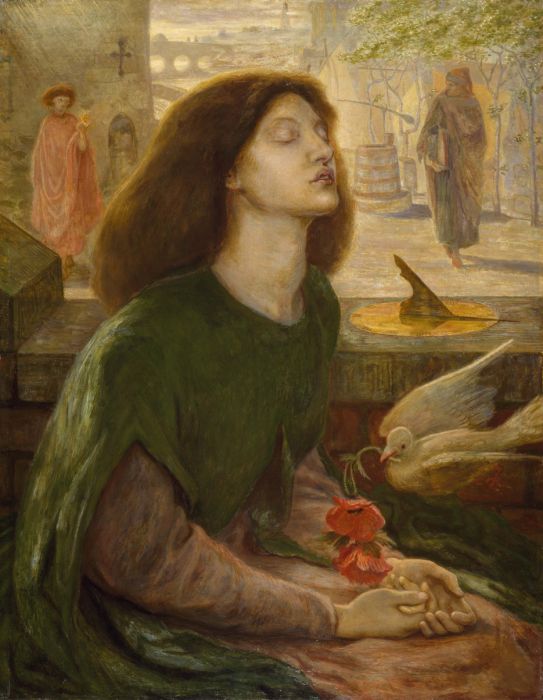
None of which I knew when we moved into our housing unit at Lakenheath, with a lawn that was covered with tiny daisies in spring and early summer, and with wild poppies in late summer and fall, so thick that friends and I would run through them over and over again toward an imaginary Emerald City. That profusion is the image invoked by Sir Thomas Henry Hall Caine in his account of the famous opening of Lizzie's grave to recover the poems DGR had buried with her seven years before: "fresh poetry and new poets arose, even as they now arise, with all the abundance and timeliness of poppies in autumn." Even so, as Stephanie Pina notes in today's blog post on LizzieSiddal.com, the choice of metaphor is striking in reference to Lizzie, for whom the cultivated opium poppy, processed into laudanum, brought relief, addiction, and finally death.
It would be half a century later, on the other side of the war whose technology irrevocably changed what war meant in Western culture, that those colors would come to denote the hope and sacrifice I mentioned at the top of this post. What they meant to DGR when he conceived the painting(s) is open to interpretation and debate. Beata Beatrix is often referred to as his tribute or memorial to Lizzie, but the more I think about his repeated execution of the design, the more it feels like an attempt to make peace with her spirit. Metaphorically speaking. (Or mostly; there are those seances with the Brownings to consider.)
But it's the inside of Lizzie's head I'm trying to explore these days. There's only so far I can or should try to puzzle out Gabriel's too! (It was a pretty scary place for a while there. I don't envy him inhabiting it.)
Song for Today: When I bought Sting's Dream of the Blue Turtles, my teenage mind was completely blown by the lyrical continuum from WWI's "lost generation" to the modern lives destroyed by the drug trade. Today, 25 years later, war and the drug trade occupy the same space, where opium cultivation appeases the Taliban and puts food on the family table.
Insighful, thought-provoking post over at Hoyden About Town on Ophelia, violence, and what is and is not in the text:On Ophelia, Who Never Got to Be a Hoyden: There is no indication in the text that Hamlet harms Ophelia physically in this scene, no stage direction and no line that specifically requires such an action for it to make sense. If anything the text suggests a Hamlet who is trying to remove himself from Ophelia’s company, not run her to ground. He says ‘farewell’ three times, as well as repeatedly saying ‘go’, ‘go to’ and ‘go thy ways’. Nevertheless, the scene is often staged with Hamlet tipping over from verbal abuse of Ophelia into physical.
In which our Diva wonders how the heck that happened
Halloween down (and much fun -- my first one in this house without a show, so I finally got to hand out candy and freak out the neighborhood kids as Zombie Tinkerbell), Election Day nearly done, and birthday just around the corner! This fall has flown.
Realized I forgot in my last post to mention one of my favorite moments in the Divine Comedy reading. In Canto 26, where we encounter Ulysses and Diomedes, Virgil turns to Dante and says, essentially, "They're Greek. Better let me do the talking." Seriously, I'm barely even paraphrasing there. I was sitting next to Racole Fisher, Storefront Shakespeare's executive director, and we looked at each other and (silently) cracked up. And nobody else seemed to get it! Yes, even in the Eighth Circle of Hell, there are geeky giggles to be had.
This coming Sunday I'll be back at Villa Verone with fellow Elgin Opera singers for our periodic casual cabaret evenings. Not sure yet what other Sundays I'm going to do, but we have six of them coming up: all through November and December, with Thanksgiving and Christmas weekends off.
Meanwhile, I'm hunkered down and bundled up (getting chilly out there, and trying to keep the ol' gas bill under control), making slow but reasonably steady progress on the Lizzie project and doing various electronic housekeeping. Promo materials for Scarlet X are in the works; I'm excited to see and share them. And as always, there are other potential projects swirling in the offing, and I'll keep you posted as any of them solidify.
I know that winter is inevitably on the way, but I'm holding tight to fall, with a little assistance from another animation Daryl made from the "Cemetery Girl" photoshoot. Enjoy the pretty leaves while we got 'em!
Or most of one, anyway. First there was the reading of excerpts from the Divine Comedy, in the original Italian by classical actor Gian Paolo Poddigue and in the Longfellow translation by Storefront Shakespeare artistic director Nora Manca, who directed me as Titania last summer. I arrived to the reading a little late -- Benedictine could use a few campus maps! -- catching the first (English) pass through Canto V just as Dante and Virgil met Francesca da Rimini. I'd have been disappointed to miss that, not just because I didn't want to walk in on Nora's performance any later than I had to, but because the wallpaper on both my netbook and my Office of Doom computer is Rossetti's three-panel watercolor illustrating that very passage. (Perfect for a widescreen monitor! Lizzie's self-portrait works better on the 4:3 monitor on my home desktop.)
Something I read recently (can't recall at the moment what it was; I've long since passed the point where all the research sort of runs together in my head) asserted that DGR missed the point, that Paolo and Francesca weren't really in love, but just gave in to momentary lust, and were actually being punished by being trapped together in the second circle with the rest of the lustful. I thought at the time that that didn't seem quite right, but it had been too long since I encountered what Francesca actually says. Which certainly doesn't sound to me like it tracks with this person's opinion, whether in Dante's words or Longfellow's translation! Maybe they didn't like the idea of true lovers being damned just because of that pesky adultery thing?
I got to meet Gian Paolo briefly after the reading, and attempt to chat in my poco poco Italiano, but it's a bit too poco for much of a chat. It's enough to follow a bit of poetry with context or, better yet, a translation fresh in my head, so it was a lovely evening all in all.
In a similar vein, on Saturday I scored a side-by-side edition of Vita Nuova on clearance at Half Price Books for two bucks. \o/ Hopefully the translation is better than the one I picked up a few years back, which I was unable to read due to its being BORING AS LINT, and which went in the donation pile after three attempts. Of course, if this one isn't better, I can jump to the Italian for a challenge. It joins the gorgeous blank book, bound in red paisley brocade, that I picked up there on my last trip for Lizzie-related jottings and sketches. It's been christened with a few of the former, but I haven't quite attempted the latter yet. It's been ages and ages since I was drawing regularly, and I need to get back in the habit.
The final bit of serendipity came this morning on Twitter, when I unexpectedly heard from Lucinda Hawksley. She's the author of the biography of Lizzie that languished on my Amazon wishlist for about four years before I happened on Stephanie Pina's interview with her on LizzieSiddal.com, and discovered that it was available under an(other) alternate title. I was having a brief conversation over there the other day about the one-woman show project, and guess the mention of Lizzie's name came up on Lucinda's radar. So chalk up another interested -- and interesting! -- party looking to see what this thing becomes. Keeping me honest and keeping me working!